Spinnin' Out of Control
The Dunning-Kruger King
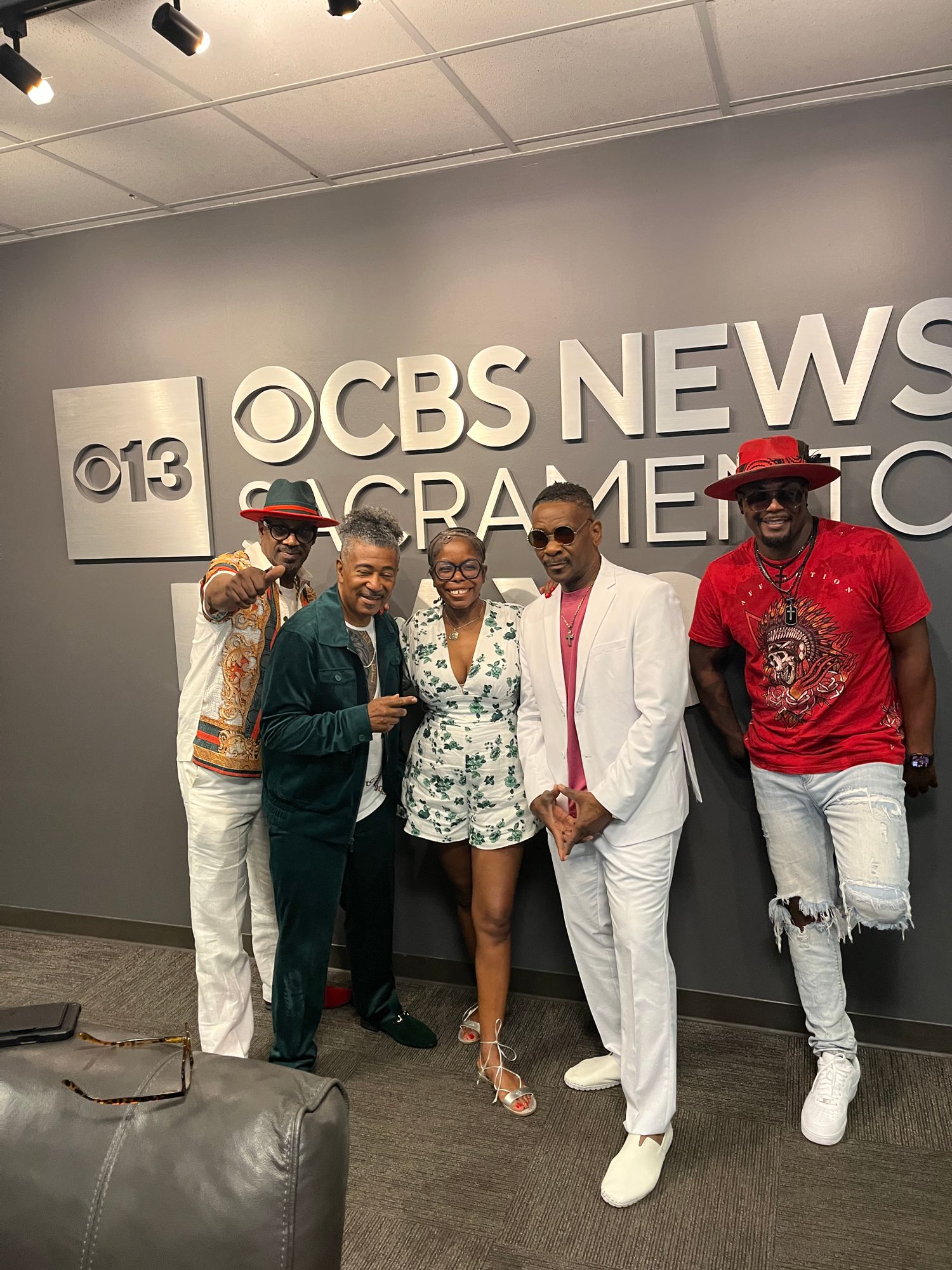
July 28, 2025: Our last-ever text exchange was incendiary. In typical fashion, the irascible busy-body old man, entrenched in chauvinism and possessed by an unexplained fixation on surreptitiously maligning my work and character to anyone who would listen, blew up on me in the course of doing my job. If you think this is another post detailing the mayhem wrought by Paul Mathis — congratulations, you’ve just been pump-faked.
Tensions had been running high between us for some time now, me and the group’s superficially charming high-octane lead singer. The inciting incident that led to our final communication was yet another one of his failures to stay in his own lane. The Dunning-Kruger effect was strong with that one.
Dunning-Kruger effect, in psychology, a cognitive bias whereby people with limited knowledge or competence in a given intellectual or social domain greatly overestimate their own knowledge or competence in that domain relative to objective criteria or to the performance of their peers or of people in general. — Brittanica, accessed January 31, 2026
A day after The Spinners played The Cache Creek Casino as part of the 70s’ Soul Jam last summer, a woman who had attended sent a profoundly moving DM to the Spinners Facebook page expressing how she’d recently been experiencing suicidal ideation. When The Spinners performed Sadie, the anthemic homage to the great matriarchal figures of the Black community, this woman had a transcendental moment that snapped her out of her depression. That woman’s Spinners concert experience caused her to reconsider harming herself.
Hers was a testimony that resonated with me in a deeply personal way. I’d lost my brother Rodney to suicide in 2007, the first of four major losses in my life that would fundamentally change me at a molecular level. As I read this woman’s message, I marveled at the healing power of music, gratified to be in such a medicinal line of work. I wanted to share her testimony, but in a way that wasn’t exploitative. So I asked this woman if I could share her testimony (with her name redacted) on my personal page, as opposed to the Spinners page.
The Spinners Facebook page had over 24,000 followers — herself now included. Were she to have a bout with self-consciousness, I didn’t want her to have to constantly revisit a vulnerable moment. Once out of the danger zone, people who overcome a struggle with suicidal ideation often feel embarrassed by it, which can trigger them into another tailspin; sharing it on my private page would minimize that risk for this woman. I have a little over 1,000 Facebook friends, with a high percentage of entertainment industry insiders. I wanted to share with my colleagues (and others) the power of our work. She obliged, and thanked me for being so thoughtful. I was happy to thread the needle between sharing her story without exposing her vulnerability to such a large audience without her consent. I proceeded to post her testimony on my Facebook page, sparking many friends to reflect on the power of music (I’ve since deleted the post in the wake of the needless donnybrook that followed).
Given all the care I took to ensure a spectacle wasn’t made of this woman’s private anguish, and having given my word to her that the post would be respectful and shared on a limited basis, imagine my dismay when I logged into the Spinners Instagram account to see that the group’s lead singer, Curt Jefferson, shared the post on his instagram page (Note: I will not be sharing the screenshot of that post here, out of respect for this woman’s privacy). For starters, he and I weren’t even connected on any social media platform by that point, and my posts are only viewable by my friends, so his posting it felt oddly violative. I opted not to share this woman’s story of hope on my Instagram precisely because my IG page is public, giving me less ability to control its distribution. I figured that one of the members of the entourage that I’m friends with on Facebook brought up my post as a topic of discussion while they were on the road (and rightfully so, what an honor to know that your work brought someone back from the brink). That didn’t bother me. What bothered me was Curt’s continued belief, demonstrated by his insolent behavior over the course of the past three years, that the usual protocols didn’t apply to him.
As the group’s publicist, the act of me posting this story to my more intimate personal Facebook page coupled with the sensitive nature of the testimony ought to have tipped him off enough to ask if there was some prevailing reason that kept me from posting it on the Spinners’ social media. However, Curt by that time had already run with the narrative he had already ascribed to me: that I was “bad at marketing.” Since he was the group’s self-proclaimed “marketing guru,” my failure to share it on the Spinners page was further evidence of my incompetence, rather than an earnest attempt to handle this woman’s moment of personal anguish with a level of discretion. Not everyone wants to be a viral story. Later on that morning, Sunday, July 27, the woman expressed that she wouldn’t mind me sharing her story on the Spinners page after all. I made plans to schedule a post on the Spinners socials later that week inspired by her testimony.
I reached out to him that day explaining to him that the screenshot was intended to be a part of a Spinners social media post later that week, “so it would have been great not to post that to your personal before it was posted to the official Spinners page. Thanks for being professional in advance and removing it.” After sending those text messages to Curt that Sunday afternoon, I went back to his Instagram page to see how many followers he had, a rudimentary attempt at risk assessment. At the time, he had fewer than 1000 followers — the risk of massive distribution of this woman’s story was de minimis. I also deduced that his posting of her redemptive tale wouldn’t steal the thunder of my post to the group’s official page planned for later that week. So about 13 minutes later, after completing my risk assessment, I sent him another text — “Actually, you know what, never mind. You don’t have that many followers so no one is really gonna notice. False alarm!” I knew he would likely refuse to comply with my request to remove the post anyway. Once I saw his low follower count, I was essentially telling him to disregard my request.
The following morning, at 6:24 AM, I got a sassy pair of messages from Curt:
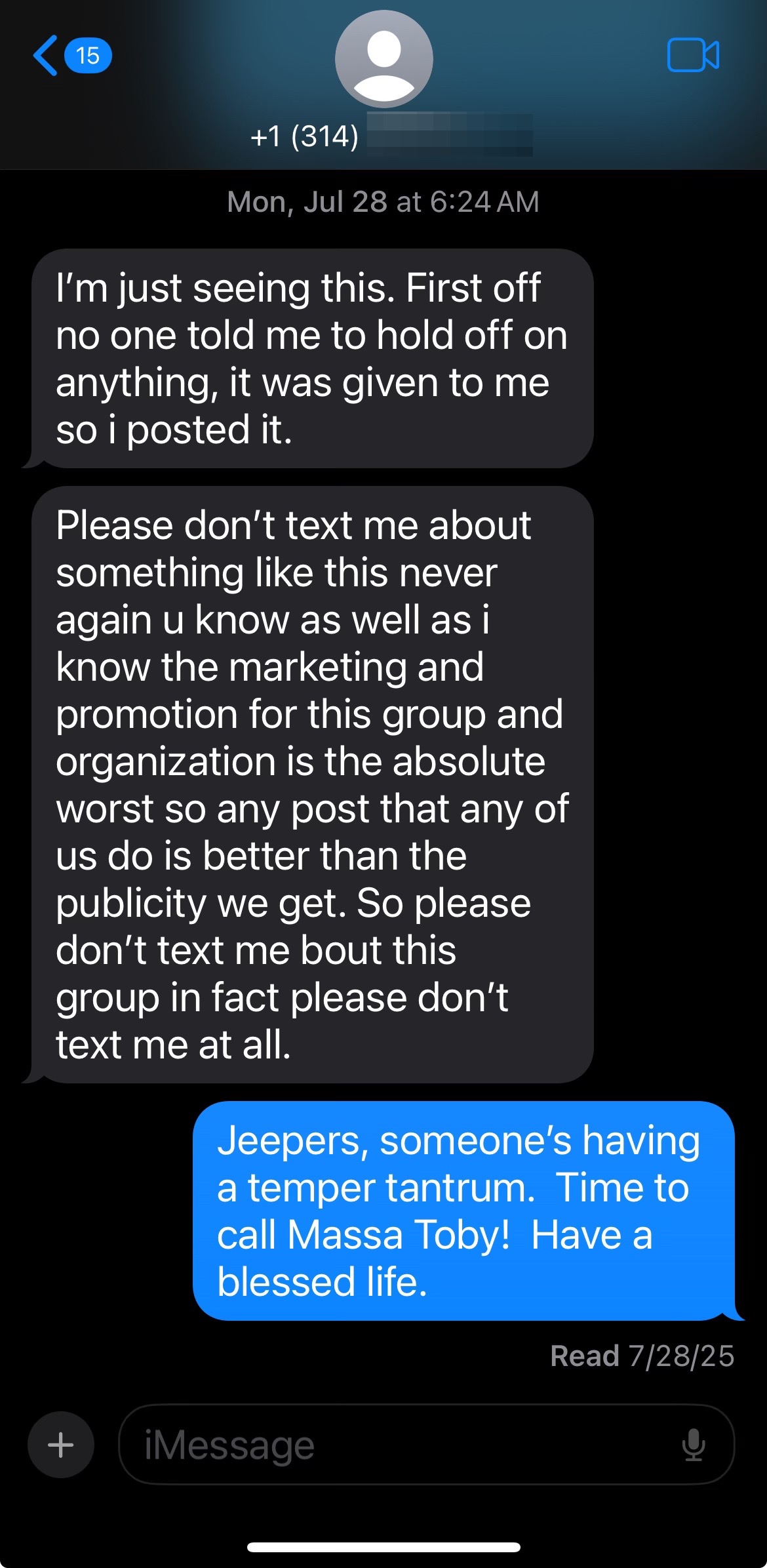
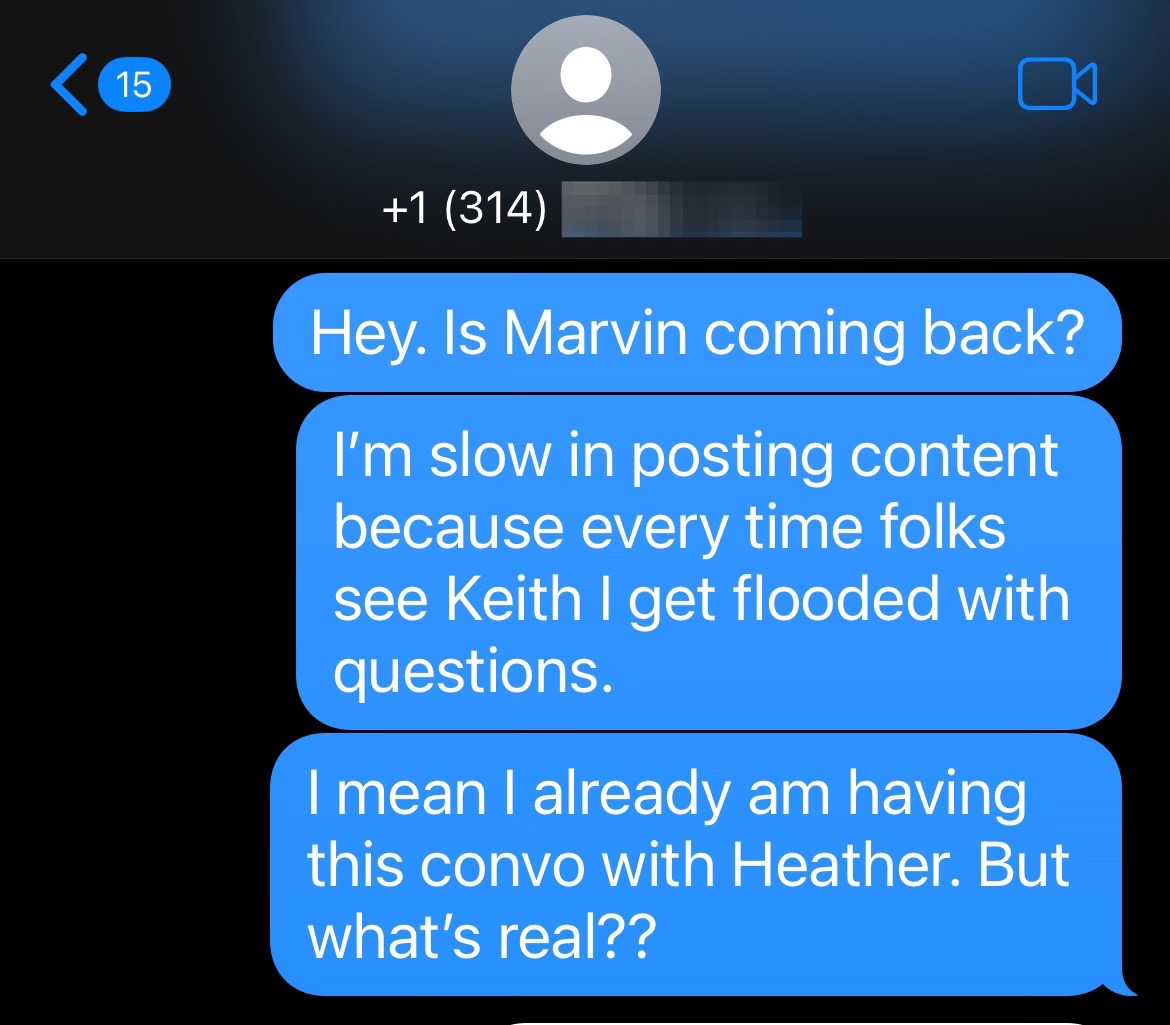
Within that crashout, the broken clock was right in one regard and wrong about everything else. “Publicity” (my métier within the group) had in fact fallen off. Just about every initiative I brought to Heather and Toby last year fell on deaf ears and empty coffers in a year when the group needed it most. Additionally, the group was in flux, and management wasn’t being very communicative with me about the long term plans for the group’s lineup. Our “Bobbie Smith” lead singer, Marvin Taylor, had left the road due to extenuating circumstances, and my decision to roll out his stand-in hinged upon whether there were plans for his return. Three years in, I had still never sat in on Spinners meetings convened by Toby and his go-fer, Will Whitney, so I didn’t have the intel. I’d actually reached out to Curt for answers before our final, acerbic correspondence, going so far as to explain why I’d not been posting as much on the Spinners social media. I responded to his abrasive texts by mocking his penchant for running to Toby Ludwig for everything — an exercise in self-emasculation if ever I saw one.
Most of my [predominantly non-Black] colleagues in the realm of legacy classic soul groups don’t make much fanfare about replacing members. “At the end of the day, audiences only care about the songs,” is the prevailing sentiment. Any ol’ singer will do. On principle, this status quo never sat right with me; it treats artists, Black artists in particular, as fungible goods. Fungible goods lack value, so if the goal is brand preservation, this approach leads to brand depreciation in the long run. More specifically, Marvin Taylor wasn’t just “any ol’ singer.” I’ve yet to hear a replacement member of any classic soul group come as close to his predecessor as Marvin comes to Bobbie Smith. The brotha was nice with it: elegant moves a la Smith coupled with a vocal intonation that was as close to Bobbie as it gets absent a séance (quite a testament to Marvin as his understudy; Bobbie was one of the most unique vocalists in the pantheon of classic soul vocalists).
Since 2023, mitigating the unacceptable level of risk to which Curt’s behavior exposed the group became an obnoxiously large piece of my portfolio — an aspect of my job to which he had no visibility. At times, I felt more like Curt’s damage control specialist rather than the Spinners’ publicist. Rather than the iterative form of PR that I so enjoyed — ideating fun activations like the Motown Museum event, cross-marketing opportunities with similar artists, inviting elite guests to shows to create buzz in elite circles, etc. — my work was taking on more of an Olivia Pope-style damage control flavor. Individuals operating under the fog of the Dunning-Kruger effect rarely take into account the existence of epistemological gaps. To put it in layman’s terms: he didn’t know what he didn’t know.
A constant refrain in his attempts to gaslight me into believing that I wasn’t the capable professional that consistently over performed in my role, was to state “our marketing and promotion sucks.” I suffered second-hand embarrassment for that guy every time he hit me with that, as I looked around for the nonexistent marketer or promoter in the room. Again with that Dunning-Kruger effect: publicity, marketing, and promotions, while somewhat similar and overlapping, are distinct disciplines. I’ve never claimed proficiency in marketing, and I don’t find it enjoyable. Marketing is more about sales, which is not suited to my temperament — I militate against being too pushy. Publicity, on the other hand, comes natural to me. I love to evangelize about the things I dig, and PR is essentially picking up a bullhorn and letting people know what hip things are out there to be aware of. So, the fact that he would even challenge my acumen about a discipline I don’t claim as a personal strength is frankly, an instantiation of his penchant for living at the intersection of “loud” and “wrong.” I won’t bore you with a detailed articulation of the distinction between marketing and publicity, but I know at least one reader who might benefit, so you can read more about the differences here.
DAMAGE CONTROL
2023 was a year in which my attention was pulled in many different directions — personally and professionally. I started the year going back and forth between Las Vegas and Pittsburgh to be at my mother’s bedside as much as possible in the final days leading up to her death on February 1 — the same day that the Spinners were announced as nominees for induction into the Rock & Roll Hall of Fame that year.
Naturally, I poured myself into my work, hoping that occupying my time would soothe my grief. Accordingly, twenty days later, I was up early in the AM scheduling social media posts — the Spinners RRHOF For Your Consideration campaign was underway, and I was diligent about publicizing their nomination. This would be the group’s fourth attempt at induction, and I was intent upon a successful result. I was fielding messages from fans on the group’s Instagram page. One of the messages I fielded that morning sent a sickening chill down my spine. I couldn’t believe what I was reading, so I sent it to Heather.
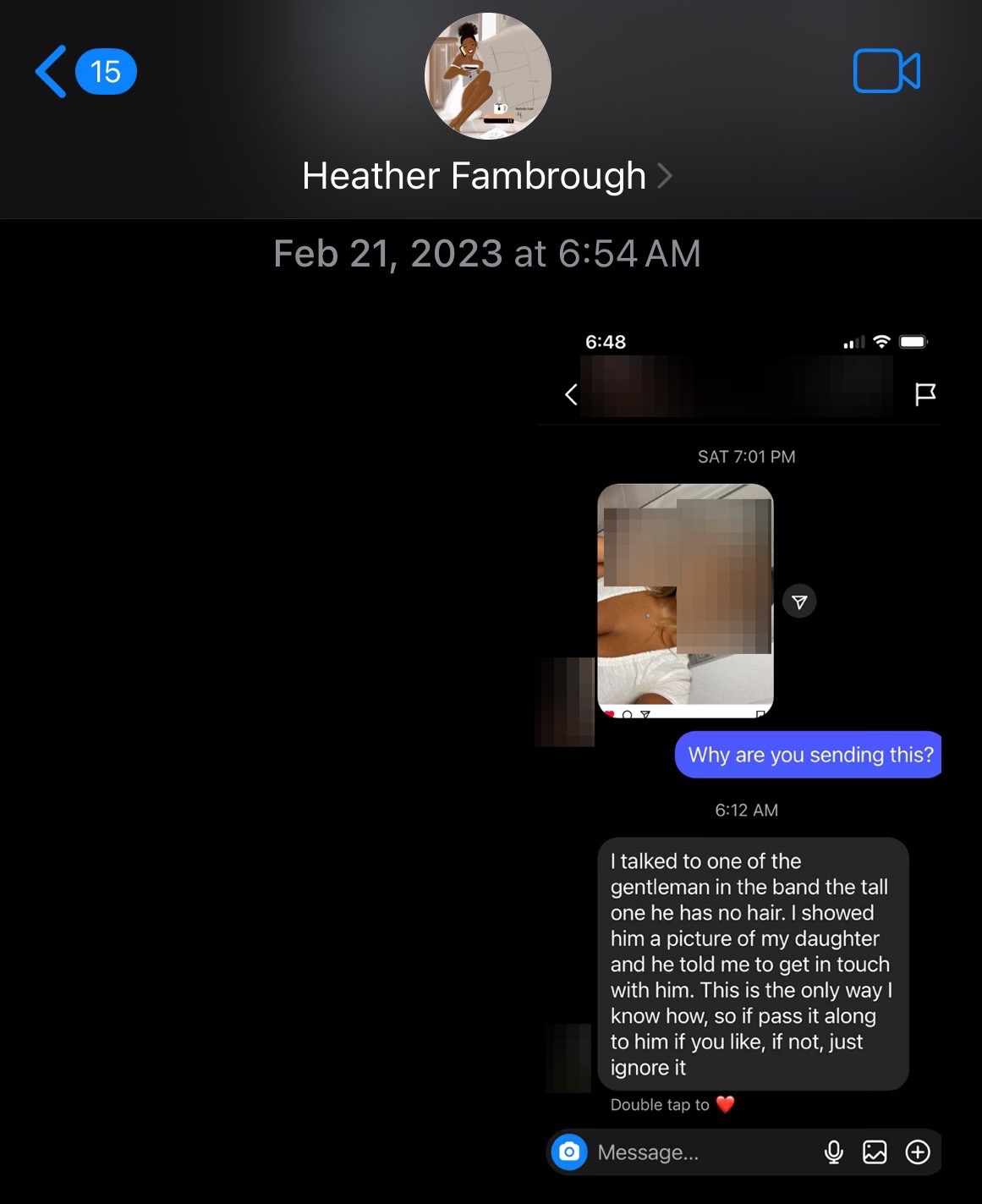
The Spinners had just played a show in New Jersey the previous evening, and a middle-aged woman in attendance had apparently whipped out a picture of her young daughter to show him. I was deeply troubled, since her daughter looked as if she could be teenaged. I’d heard of this type of thing happening before, mothers pimping their daughters to prominent men — it is the entertainment business, after all. I immediately thought of the potential risk of liability — for myself and for the group. Would I be retaliated against if I didn’t pass along the message? What if this woman took issue with the denial of access and falsely accused one of the men of something improper? As a publicist (not marketer, not promoter), my mind immediately went into risk assessment and mitigation mode. Heather’s mantra echoed in my head: The Spinners are a class act. This was antithetical to that ethos. Hell, I felt smarmy just fielding the message.
I thought it best for the buck to stop with Heather with respect to such sensitive subject matter, so I immediately sent her a screenshot of the message seeking guidance on how best to craft a response that protected the Spinners from any potential liability. In my messages to Heather, I even brought up the possibility that perhaps Curt was blowing her off by sending her to the Spinners Instagram.
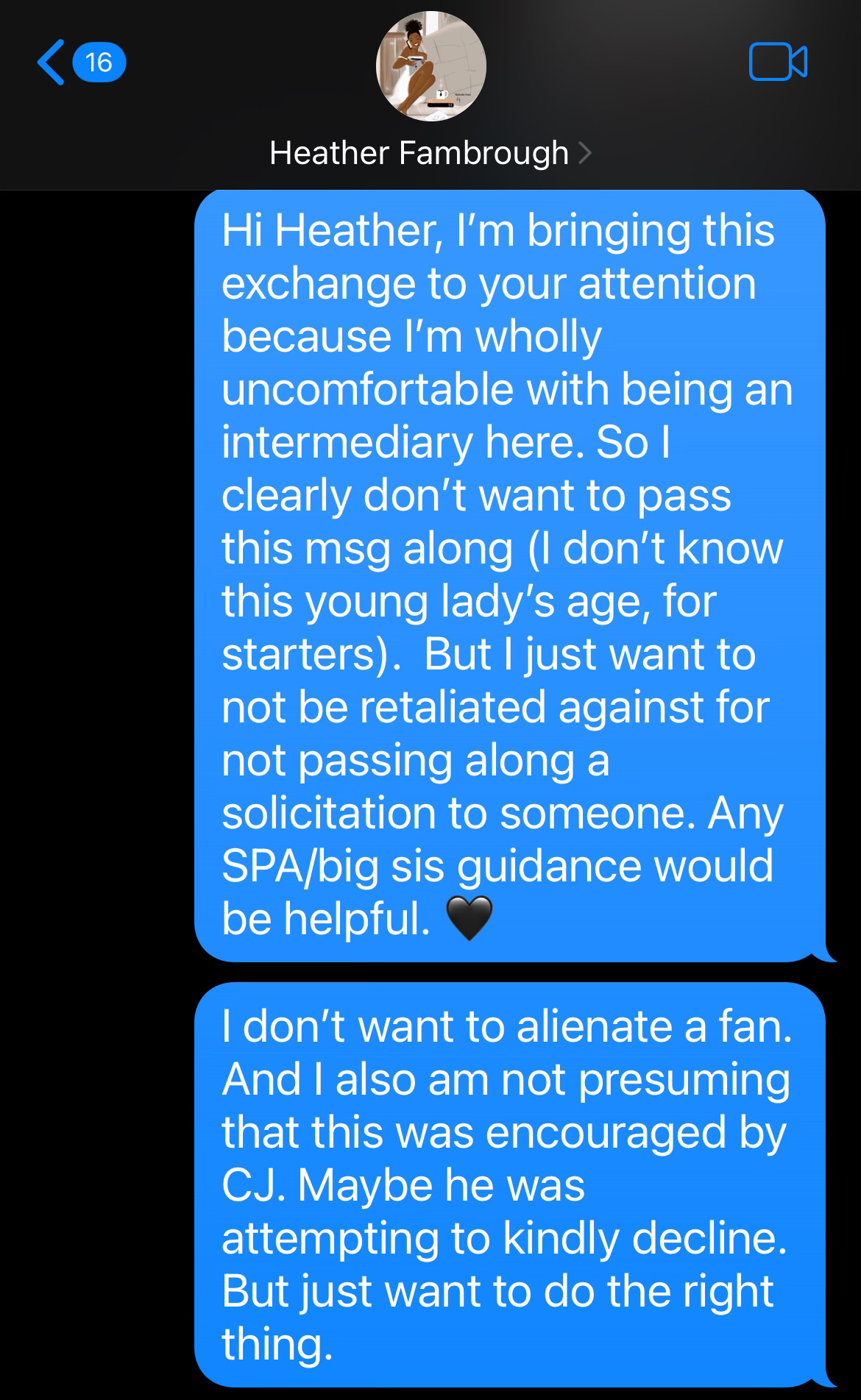
Heather responded with an appropriate show of disapprobation. I expressed my concerns about the potential for retaliation if Curt discovered I didn’t pass along the message. The pattern of scapegoating me for the most picayune matters had already been well-established within the Spinners organization by February 2023, so my concerns were well-founded.
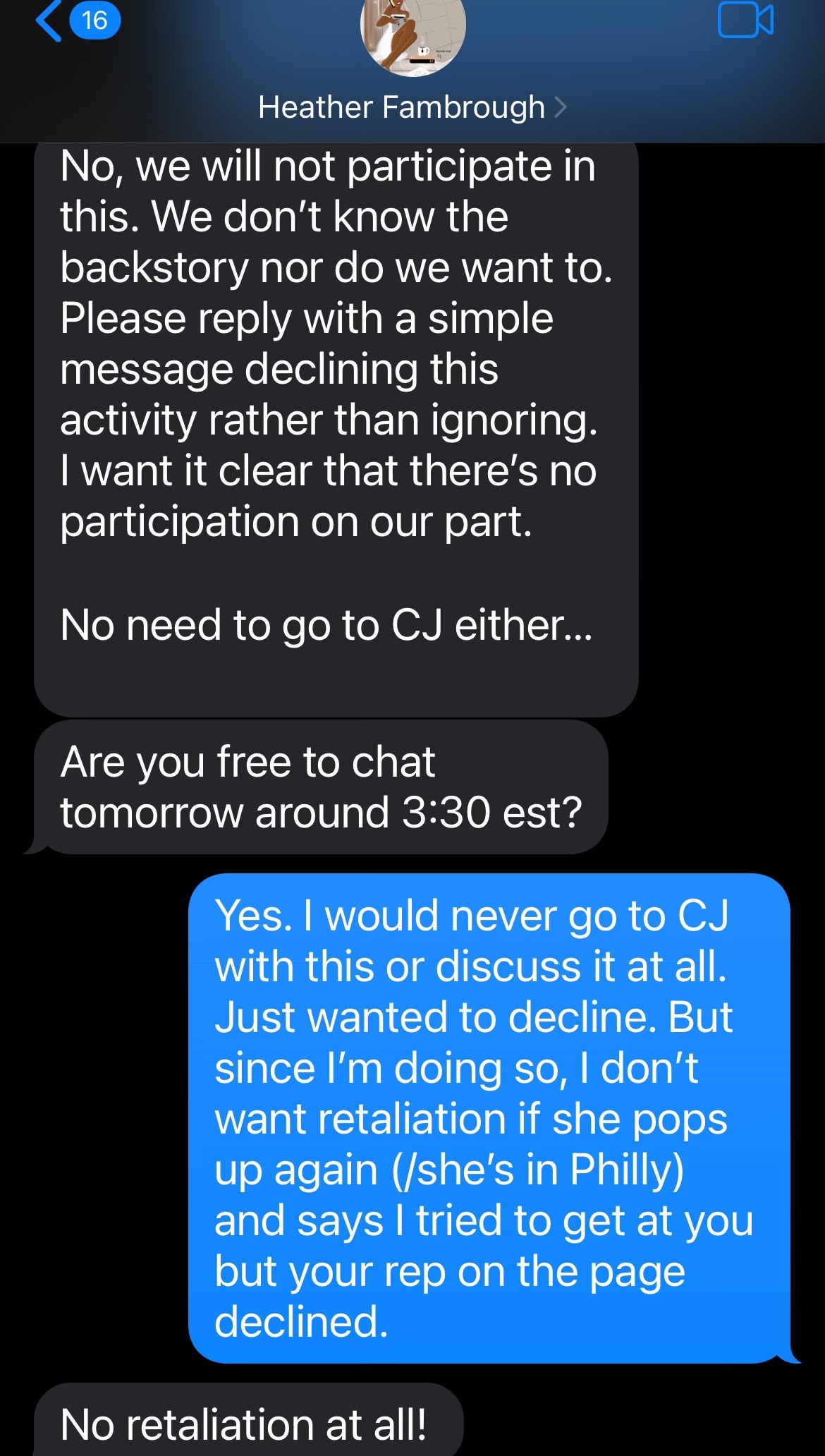
Her response — no retaliation at all! — feels tragically ironic today. I drafted a brief response to this mother’s salacious solicitation (humor me) and sent it to Heather for approval. She approved it, with a minor addition.
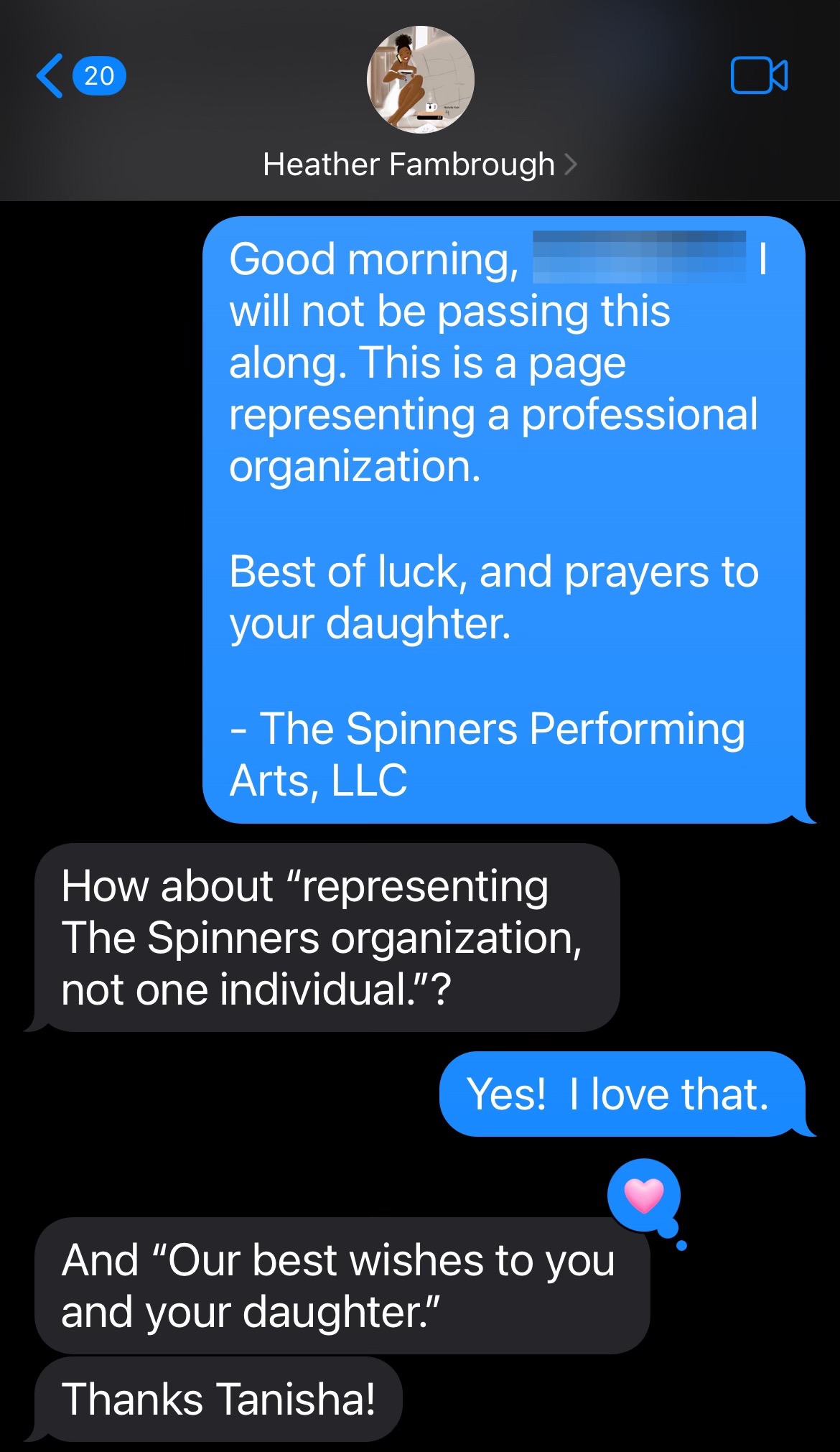
I sent the message and went about my way. Crisis averted. I put the incident under my hat, making it a point to be mindful of this sort of activity now that I’d been made aware of it.
The next couple months were a flurry of meetings, interview requests, press releases, trips to Detroit to prepare the Spinners uniforms for the donation to the Motown Museum, and very little sleep. My nose was to the grindstone, and honestly, I loved every minute of it. I love the feeling of purposeful action, particularly for a cause I’m so passionate about. Professionally, I was in my glory. Things were chugging along at a rapid clip, when I received another troubling message sometime in April 2023 concerning Curt that posed both PR and legal risks to the organization, darkening the proverbial doorway of the Spinners Facebook page.
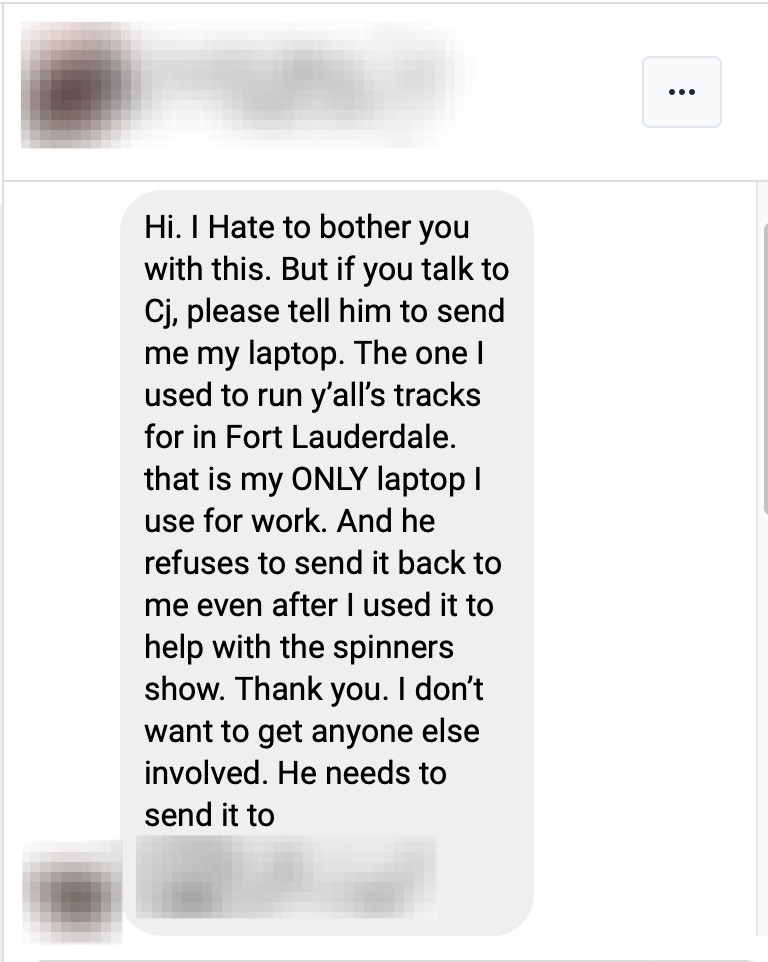
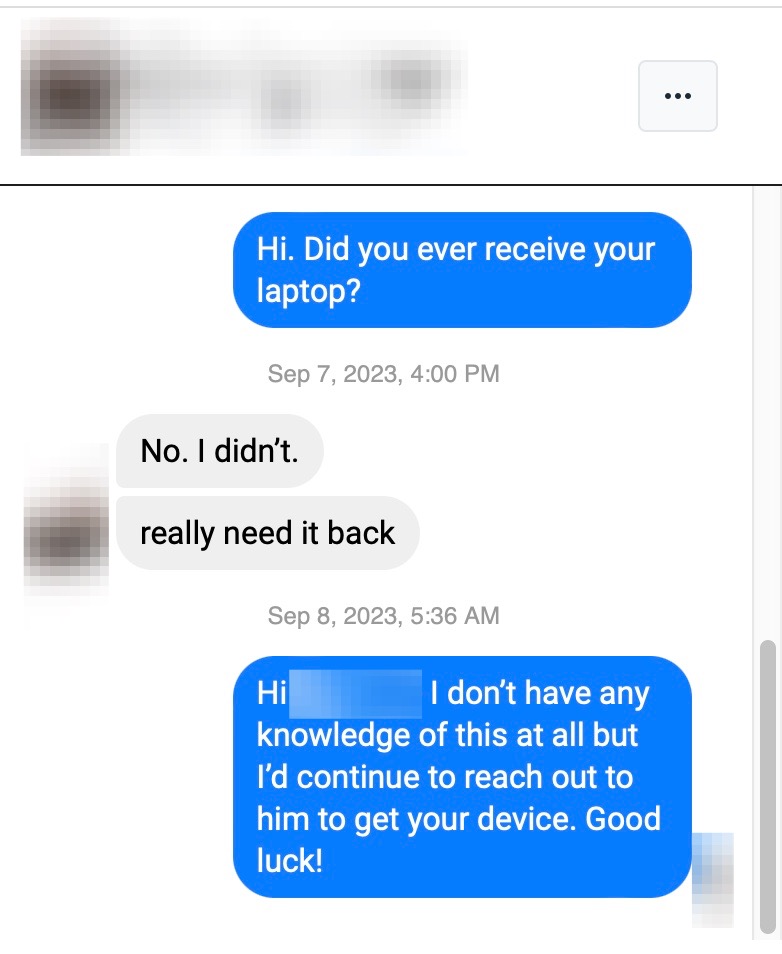
I was awake enough in class at William and Mary Law School to know that the doctrine of Respondeat Superior could expose the SPA to liability. This woman was alleging that this man was hanging on to her laptop (why? You know what, never mind, above my paygrade), which was used in the course of Spinners business for a month-long tour. My immediate response was that she should reach out to him directly — I didn’t know what else to do other than to apprise Heather once more that his choices were exposing the group to unnecessary legal exposure and reputational harm. When I followed up with this young lady in September of that year (the Rock & Roll Hall of Fame PR campaign was well underway, and I wanted to ensure nothing ran amok), he still hadn’t returned her laptop.
Finally, in June, yet another bit of troublesome news appeared in the form of a Facebook message from a disgruntled woman.
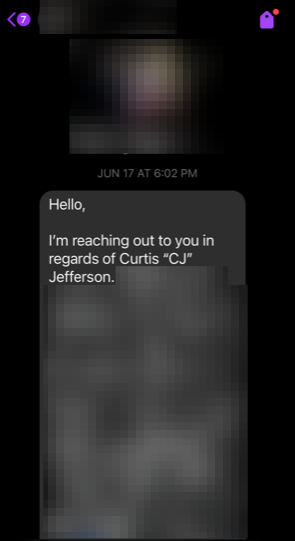
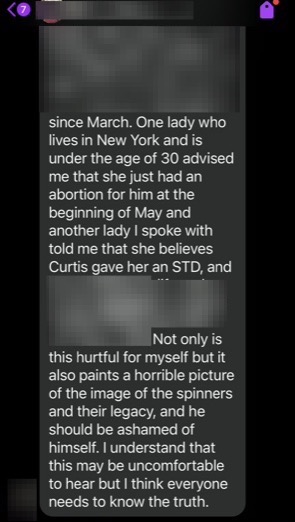
Alarm bells were going off. I closed my laptop and turned on an episode of Mad Men, because who doesn’t find comfort gazing at Jon Hamm? Why, I wondered, why all of this craziness in THIS year? My world was rocked. If this woman was angry enough to send a message to Curt’s employer, what havoc could she wreak on Henry’s and John’s RRHOF victory lap? I didn’t concern myself with the behavior — live and let live. Just that his living was jeopardizing the organization at the worst possible time. I had precious little bandwidth to devote to such tawdry matters, but these are precisely the sorts of matters a publicist (not marketer) concerns herself with. So I shifted gears into risk mitigation mode, making the executive decision to revert back to the Spinners tradition of delegating the role of spokesperson to the bass singer. That actually freed two birds with one key — Jessie was the most eloquent, polished member when it came to interviews and he is quite well-versed in Spinners history. Since Jessie’s low-end predecessor (Pervis Jackson) was the spokesperson for the group back in the day, I could frame the switch as a nostalgic return to the old ways as opposed to a knee-jerk response to a PR kerfuffle.
The goal, of course, was to avoid waving a red flag in front of a raging bull. Seeing Curt in a moment of triumph with the Spinners on a morning talk show could trigger more retributive action from this woman. I sought to limit the Spinners’ exposure by limiting his exposure, so I further decided I’d scale back on television appearances for the group in the run-up to the Rock & Roll Hall of Fame. Two things were working in my favor: the writers’ strike had a chilling effect on daytime television, so there weren’t that many opportunities for the Spinners to appear on television. Besides, Henry Fambrough was the man of the hour, so the circumstances were working out in my favor.
Heather seemed equal parts overwhelmed and lackadaisical about all of this, so I didn’t run any of this strategy by her — it wasn’t her area of expertise, clearly. I simply handled these aberrant matters quietly, effectively, and without fanfare. The natives were growing restless, though. The principal members began to question why I hadn't booked them on any television shows, particularly — wait for it — Curt. The cause of the consequence was questioning… the consequence he caused, blissfully unaware of the central role he played in the lack of television interviews. I couldn’t win for losing with the Dunning-Kruger King.
The writers strike ended on September 27, but for reasons aforementioned, I still wasn’t comfortable with the idea of the Spinners — with Curt in the lineup — appearing on television. We were in the final stretch before the Rock & Roll Hall of Fame Induction Ceremony at Barclays Center in Brooklyn (held November 3 that year), and I didn’t want anything to mar Mr. Fambrough’s long-awaited, richly deserved moment. For obvious reasons, I could not divulge to the group members precisely why I wasn’t booking them for television appearances.
Another group member, Ronnie Moss, took matters into his own hands, reaching out to a producer at The Portia Show to snag an appearance on the Fox 5 Atlanta talk show. I wasn’t used to singers interfering in PR matters — most I encounter want nothing to do with it. Their meddling had the effect of making the group appear desperate to industry insiders while simultaneously making me look like I didn’t have a handle on things. Toby approved a budget for the Spinners to travel to Atlanta for this ill-advised interview without deferring to me — he never missed an opportunity to sabotage me. Another of the chaos agents that gravitated to the Spinners orbit, a crazed and devious Sunday school teacher from Philadelphia who had finagled her way into becoming a merch table volunteer for the group, wound up cosplaying as the group’s “PR Lady” for the day. Leave it to an amateur to think that a TV appearance without strategy behind it is some kind of PR win. Dunning-Kruger effect like a MOTHA.
The interview made me cringe. All year, the men had felt slighted by the harsh reality that the Rock Hall had no interest in them as the torchbearers of the Spinners legacy — a stance the Museum has long held toward replacement members of legacy groups. On a call a few months earlier, Curt even expressed that they should be inducted too. Ronnie in particular could barely contain his displeasure, and that reflected on camera, oftentimes coming off as bitter. I didn’t think the entitled attitude would go over well with fans of the original members of the group, some of whom weren’t quite sold on replacement members in the first place. When I learned of the plans for this media appearance, the ball was already rolling, tickets purchased, producer in contact with the cosplay publicist. The interview was shot in Atlanta that November after the Induction Ceremony. Little did they know that at the Rock Hall ceremony, I had a brief chat with Tamron Hall (who complimented my lewk, thank you very much). When I introduced myself as the Spinners publicist, she asked me to get in contact with her producer about having Henry on with the rest of the group — she wanted an exclusive. I could not give that to her once they committed to The Portia Show. Another missed opportunity, sponsored by the omnipresent Dunning-Kruger effect.
I couldn’t understand the sudden “Everybody Hates Tanisha” groupthink that seemed to have pervaded the group. After all, I’d just garnered them their biggest media moment in nearly four decades, I’d invigorated the group’s previously underperforming social media pages, and scored interviews with the likes of Apple Music. I’m sorry, I was too deep in my bag to be gaslit into thinking otherwise. I was beginning to feel like my success was breeding contempt; and that Toby, Curt and other chaos agents were opportunistically fueling the fire of discontent.
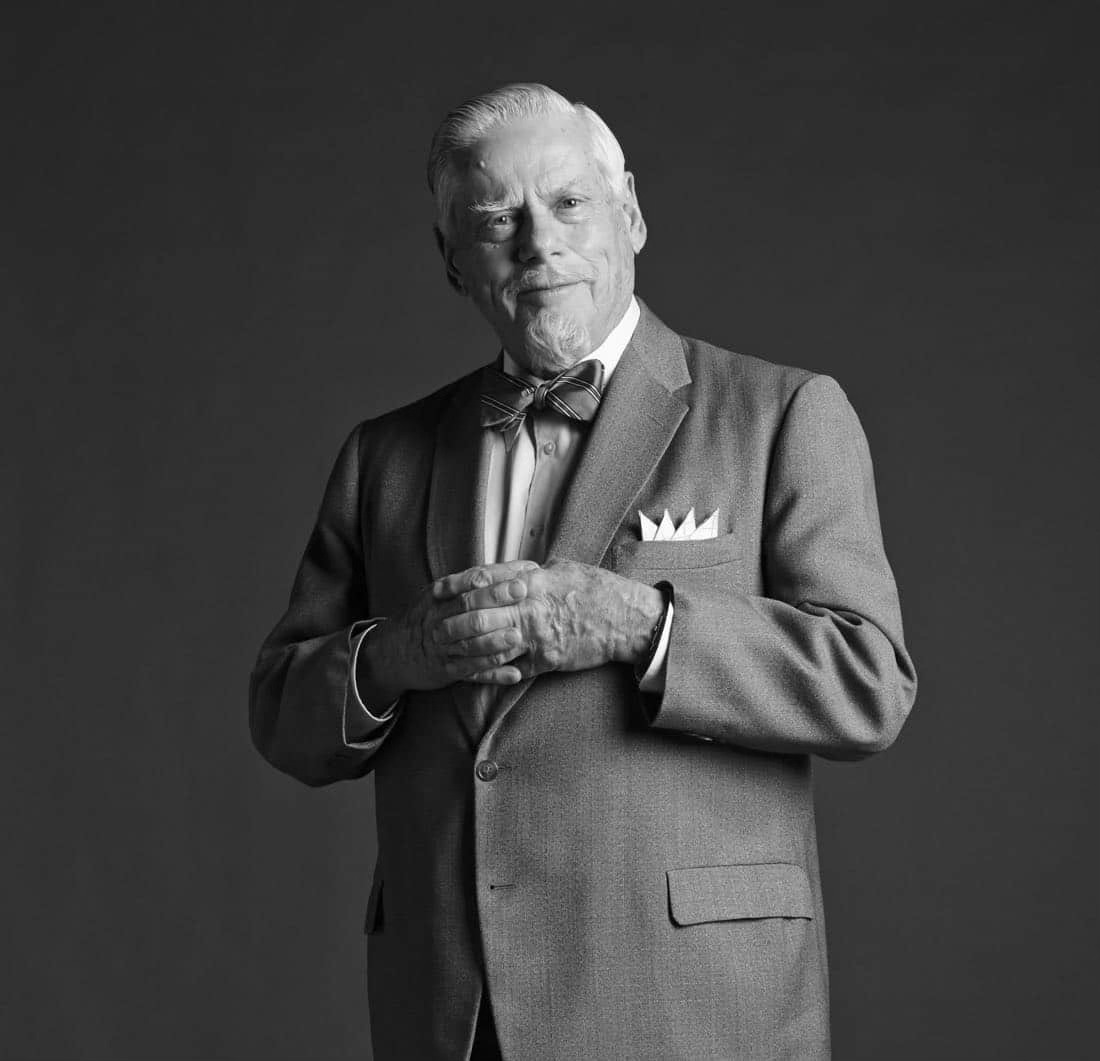
After spending much of the year cleaning up behind and protecting the group from Curt’s messes, only to have him leading the charge in attacking my work, I thought of one of my favorite Mad Men witticisms, uttered by Bertram Cooper (played by the late, brilliant Robert Morse in his final role): “Sacajawea carried a baby on her back all the way to the Pacific Ocean. And somewhere, that baby thinks he discovered America.” Couldn’t have said it better myself, Bertie, couldn’t have said it better my gotdayum self.